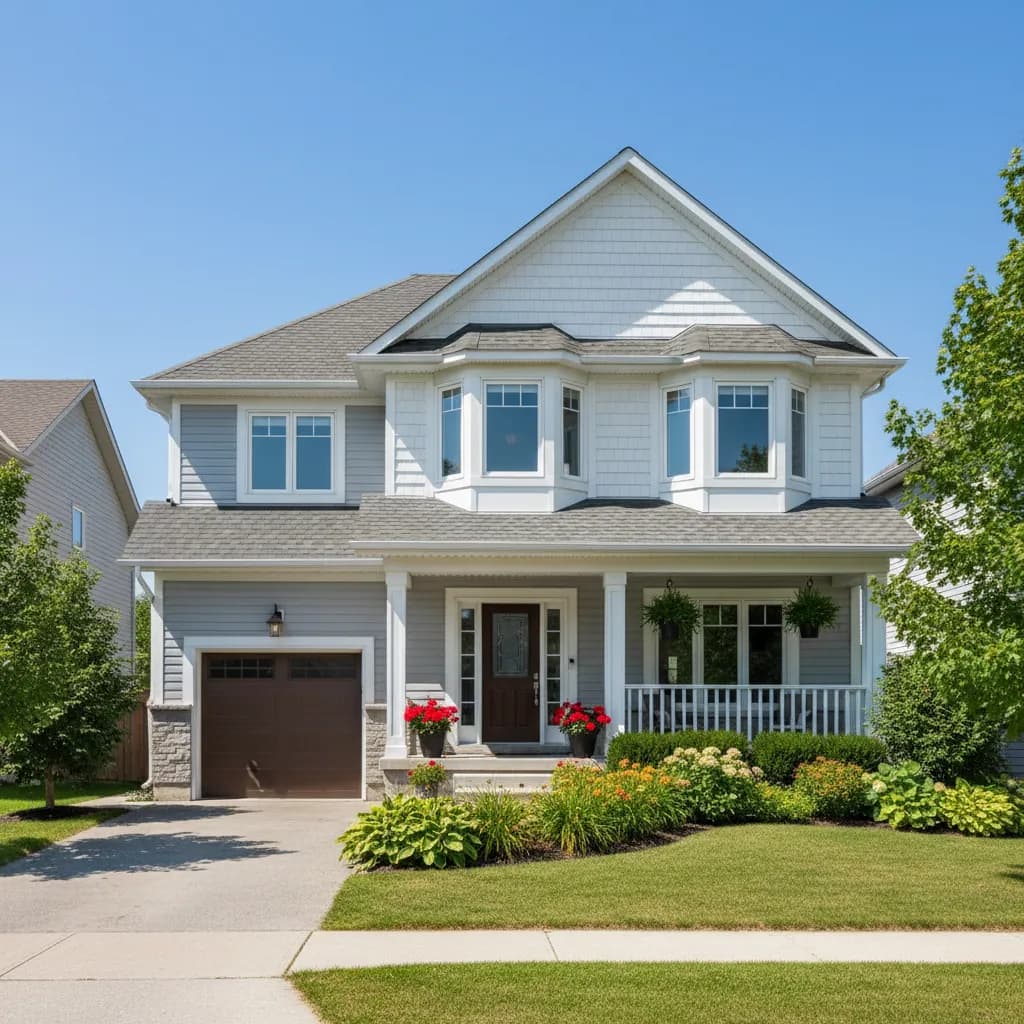
Why Accurate Comps Matter More Than Online Estimates
Why manual comparable property analysis beats automated property value estimates. Real data shows why comps are more reliable.
Why Accurate Comps Matter More Than Online Estimates
Every homeowner has checked an online estimate of their home's value at some point. Most think it's wrong. Many realtors confidently dismiss these automated valuations as unreliable. But why?
The answer isn't that these tools are incompetent — it's that comparing homes is fundamentally hard. This article breaks down what makes comps more reliable than automated estimates, and why the right methodology matters for every listing presentation.
1. The Online Estimate Problem: National Algorithm vs. Local Reality
Automated valuation models (AVMs) used by online property estimate tools rely on machine learning and public data. Sounds sophisticated — but there's a critical flaw: they can't see inside homes.
What an AVM Knows
- Property address and registered lot size
- Public tax records (beds, baths, year built)
- Historical price data
- Square footage (sometimes inaccurate)
- That's it.
What an AVM Doesn't Know
- Kitchen condition (is it 1980s avocado or 2024 quartz?)
- Bathroom updates (original fixtures or recently renovated?)
- Flooring (hardwood, carpet, or deteriorating tile?)
- Roof age (original or replaced 5 years ago?)
- HVAC systems (new furnace or 30 years old?)
- Overall condition (move-in ready or needs work?)
- Recent improvements (the $50K kitchen reno just completed)
- Defects (foundation issues, mould, pest damage)
Real-World Impact
Two homes, same address block, same year built, same "4 bed, 2 bath":
Home A: Recently renovated kitchen ($60K), updated bathrooms, new roof. Online estimate: $450,000
- Actual market value: $480,000–510,000
Home B: Original kitchen (35 years old), dated bathrooms, roof is 25 years old. Online estimate: $450,000
- Actual market value: $380,000–420,000
The AVM's error: Both estimated the same ($450K) because it can't see inside. Yet they're worth $100,000 apart.
2. How Big Is the Online Estimate Accuracy Problem?
Leading AVM providers publish their own accuracy data. On-market homes (active listings) typically show roughly 2% median error — but off-market homes often show 7% or higher.
| Scenario | Typical AVM Accuracy | Margin of Error |
|----------|---|---|
| On-market homes (active listing) | ~2% median error | Most within 5% |
| Off-market homes (not listed) | ~7% median error | Many 10–15% off |
| Homes that just sold | ~2% median error | Varies by condition |
What does 7% error mean?
On a $400,000 home, 7% is $28,000. That's the difference between a fair price and a bad deal.
On a $600,000 home, 7% is $42,000.
In practice, off-market errors are often higher than published figures. Many homeowners check an online estimate and find it's 15–25% off actual market value.
3. Why Comps Are More Reliable: The Data Approach
A professional comparable sales analysis (CMA) works differently.
The Comp Methodology
- Find recent sales of similar homes in the area
- Verify actual sale prices (not estimates — actual closed deals)
- Adjust for differences (kitchen updated? Roof newer? Add/subtract value)
- Create a range (low to high based on comp variations)
- Apply market conditions (is the market favouring buyers or sellers?)
Why This Works Better
Comps use real data: Actual sale prices from homes that actually sold. Not estimates, not algorithms — real market validation.
Comps account for condition: A realtor walking through a home can grade condition (C1–C6) and adjust pricing accordingly. An algorithm can't.
Comps are local: A good CMA focuses on recent sales within 1–2 km of the neighbourhood. It accounts for local micro-markets.
Comps are adjustable: If a home has a feature no comp has, a realtor can estimate its impact. An algorithm is static.
Comps have human judgment: A realtor can say "This comp sold for $450K but the buyer got a great deal and the home was priced aggressively. In our normal market, this home would be $475K."
An algorithm can't make those nuanced judgments.
4. Real-World Comparison: Comps vs. Online Estimates
Example 1: The Renovated Kitchen
Home: 4-bed, 2-bath, 1,850 sqft, $480,000 neighbourhood
Recent change: $60K kitchen renovation (new appliances, cabinets, quartz counters)
Online Estimate: $470,000 (doesn't know about renovation)
Comp Analysis:
- Comp 1: Similar home, no kitchen update, sold 3 months ago: $450,000
- Comp 2: Similar home, recent kitchen update, sold 2 months ago: $485,000
- Comp 3: Similar home, custom kitchen, sold 1 month ago: $510,000
- Realtor's CMA: $485,000–$510,000 (accounts for quality kitchen update)
Winner: Comps. The CMA immediately identified that the renovation likely added value.
Example 2: The Aging Roof
Home: 3-bed, 1-bath, 1,200 sqft in $300,000 market
Issue: Roof is 27 years old, likely needs replacement within 1–2 years
Online Estimate: $295,000 (no awareness of roof age)
Comp Analysis:
- Comp 1: Similar home, new roof (replaced 5 years ago): $310,000
- Comp 2: Similar home, unknown roof age: $295,000
- Comp 3: Similar home, roof needed replacement soon: $265,000
- Realtor's CMA: $270,000–$290,000 (adjusts down for roof replacement cost)
Winner: Comps. The CMA identifies the financial impact of a roof replacement.
Example 3: The Micro-Market Shift
Home: In a neighbourhood that's rapidly gentrifying
Online Estimate: Uses last 3 years of sales data, says $420,000
Comp Analysis: Realtor notes:
- 6 months ago: Average $400,000
- 3 months ago: Average $415,000
- Last month: Average $430,000
- Current market: $435,000–$445,000 (shows rapid appreciation trend)
Winner: Comps. The local realtor sees the trend that algorithms miss.
5. When Online Estimates Actually Work Well
Automated estimates aren't useless. They work reasonably well in certain situations:
✅ Online Estimates Work Decently For:
- Newer homes (where condition is relatively standard)
- Homes in uniform neighbourhoods (cookie-cutter subdivisions where most homes are nearly identical)
- On-market homes (where actual listing data feeds the algorithm)
- Homes with no defects (fewer variables for the algorithm to miss)
- General sanity checks (is the asking price in the ballpark?)
❌ Online Estimates Struggle With:
- Older homes (more variation in condition, more updates/defects)
- Unique homes (unusual features, less comp data)
- Recently renovated homes (algorithm doesn't know about updates)
- Homes with defects (foundation issues, roof needing replacement, etc.)
- Homes between markets (transitioning neighbourhoods with price volatility)
- Off-market homes (not actively listed — too little data)
6. AVM Accuracy Has Improved, But Structural Limits Remain
Online estimate tools have improved over the years through better data integration and machine learning. But they still have structural limitations no amount of training data can fully solve: they can't see inside homes, and they can't factor in local market knowledge that an experienced realtor brings to every CMA.
The real estate industry has learned this lesson the hard way. Major platforms that relied on AVM-based pricing to buy and sell homes at scale ran into significant losses when market conditions shifted and the models couldn't keep up with reality.
If billion-dollar companies couldn't make AVM pricing reliable enough for large-scale transactions, what does that tell you about using one as your sole pricing reference?
7. How Professional Realtors Use Comps (The Right Way)
A realtor's CMA typically includes:
1. Primary Comps (5–7 Most Similar Sales)
- Within 1 km of subject home
- Similar beds/baths/sqft (within 10–20%)
- Sold within 3–6 months
- Similar condition grading
2. Secondary Comps (3–5 Adjusted Sales)
- Slightly further away or different specs
- Used to validate primary comps
- Helps establish price range boundaries
3. Adjustments Made
- Price per square foot
- Condition adjustments (C1 vs. C4 difference)
- Date adjustments (if market is trending up/down)
- Feature adjustments (garage, basement finish, extra bath)
4. Market Analysis
- Days on market (how long homes are selling)
- Sale-to-list ratio (what % of asking price homes actually get)
- Inventory levels (supply/demand balance)
- Price trends (up, down, or stable)
Result
- Recommended list price range (e.g., $485,000–$515,000)
- Justification for that range (backed by data)
- Marketing strategy based on market conditions
8. The Bottom Line for Sellers: What You Should Do
If You're Selling
- Don't rely on online estimates for listing price. Get a CMA from a realtor.
- Get multiple comps (ask your realtor for their analysis).
- Have your realtor explain why each comp is relevant.
- Ask about adjustments (how does your home compare to each comp?).
- Understand the range (list price isn't a magic number; it's a range).
If You're Buying
- Research comps yourself (know the market value before making an offer).
- Use comps alongside online estimates (triangulate for a sanity check).
- Get an appraisal (required by most lenders anyway).
- Trust your realtor's market knowledge (they know local nuances).
If You're a Realtor
- Use comps as your foundation (not algorithms).
- Get local recent sales data (not national averages).
- Adjust for condition (C1–C6 grading makes a huge difference).
- Stay current (market conditions change monthly, update your analysis).
- Justify your analysis (sellers deserve to understand your CMA).
9. The Future: AI That Actually Works
The good news? Better AI is coming. Some proptech companies are now incorporating:
- Computer vision (analyzing photos to assess condition)
- Local market data (recent comps, not just historical averages)
- Feature detection (identifying upgrades automatically)
- Realtor-in-the-loop (AI assists but doesn't replace human judgment)
The best solutions blend algorithmic speed with human expertise. The worst rely purely on automation with no local knowledge.
Final Thought
Online estimates popularized the idea that anyone could instantly know their home's value. That's been powerful for the real estate market — it's created informed buyers and sellers who come to the table with data.
But it's also created false confidence. Homeowners see a number and think they know their home's value. Sellers price unrealistically. Buyers make uninformed offers.
The reality: Accurate pricing requires understanding condition, local market dynamics, and recent comp data.
Comps matter because they're based on what homes actually sold for, not what an algorithm thinks. In real estate, actual data beats estimates every time.
Disclaimer: This article discusses general real estate valuation methods and compares manual comparable sales analysis to automated valuation models (AVMs). AVM accuracy varies by market and property type. Actual property values depend on numerous factors including condition, market conditions, location specifics, and individual buyer preferences. Never rely on any single valuation method for critical financial or transactional decisions. Always consult a licensed appraiser, real estate professional, or both before making listing, buying, or financing decisions. Hausprice provides valuation information for educational purposes and as one data point among many in the valuation process.
Back up your pricing recommendation with data.
Generate a professional, client-ready report in 3 minutes — AI photo analysis, comps, and condition assessment included.
Generate a Report